Measurement & Safety
STA-OPTS
STA-OPTS Optoelectronic Detection System
A modular characterisation platform for photodetectors, photovoltaic cells and semiconductor thin films. Combine controlled monochromatic illumination with low-current acquisition to measure I-V, I-T, responsivity, quantum efficiency, transient response and noise.
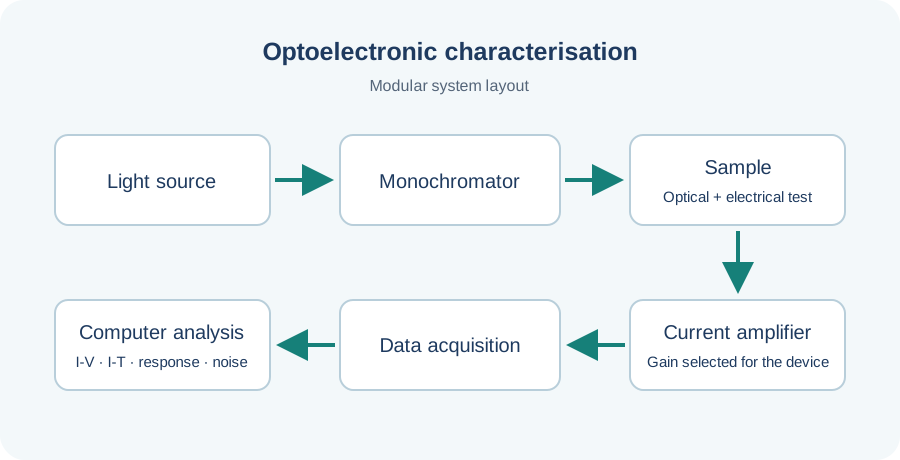
How the measurement works
A computer controls the light source and monochromator while electrical bias and current acquisition track the device response. The system includes a vibration-isolated platform, microscope, current amplifier, digitiser and measurement software.
Features
- Automated monochromatic wavelength scans
- Dark-current, photocurrent, output and transfer curves
- I(R)-T, dual-axis pulse I-V and repeat overlays
- Responsivity and quantum-efficiency workflows
- Low-frequency, ultra-low-frequency and 1/f noise analysis
- DC/AC switching; RMS, vector and peak processing; up to 500 averages
- BMP image and XLS data export
- Selectable amplifiers; listed response below 100 ns with suitable module
- Laser-diode drive option with listed current rise time below 50 ns
- Time-domain selection, bandwidth fitting and bad-point removal
Applications
- Physics and materials science
- Sensors and photovoltaic devices
- Perovskite and semiconductor-device research
Technical specifications
Optical and electrical specifications
| Parameter | Specification |
|---|---|
| Model | STA-OPTS |
| Wavelength range | 300-2500 nm |
| Spectral resolution | 1 nm |
| Bias voltage | ±10 V |
| Current resolution | <10 fA |
| Data sampling rate | 2 MS/s |
| High-speed current gain | 10^3-10^11 |
| Low-speed current gain | 10^2-10^14 |
| Low-frequency baseline noise | 2 × 10^-29 A²/Hz |
| Ultra-low-frequency baseline noise | 1 × 10^-31 A²/Hz |
| Low-frequency noise band | 1 Hz - 100 kHz |
| Ultra-low-frequency noise band | 0.01-10 Hz |
Configure your measurement
Include these details with your enquiry so we can match the instrument and accessories.
- Device geometry, electrodes and two-/three-terminal needs
- Wavelength span, required optical power and calibration
- Bias, current range, amplifier module and measurement bandwidth